



3.52
The efficiency class label evaluated based on customer preferences.
Delticom centralized survey results from more than 40.000 customers from 15 European countries and created this index.
More than 5 billion kilometers. Testcauciucuri.com offers over 430 000 tests firsthand - from consumers for consumers.
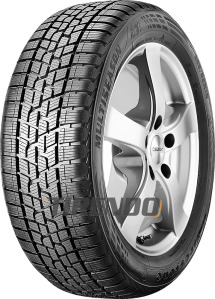
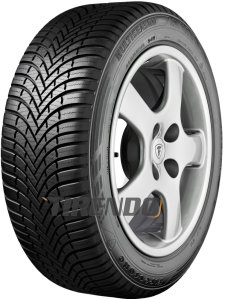
(The rim on the picture is for illustrative purposes only.)
Firestone Multiseason
195/65 R15 91H
-
1 x Firestone Multiseason 195/65 R15 91H =46.70 £1 x Castrol 5 Litre Canister =32.65 £
- Description
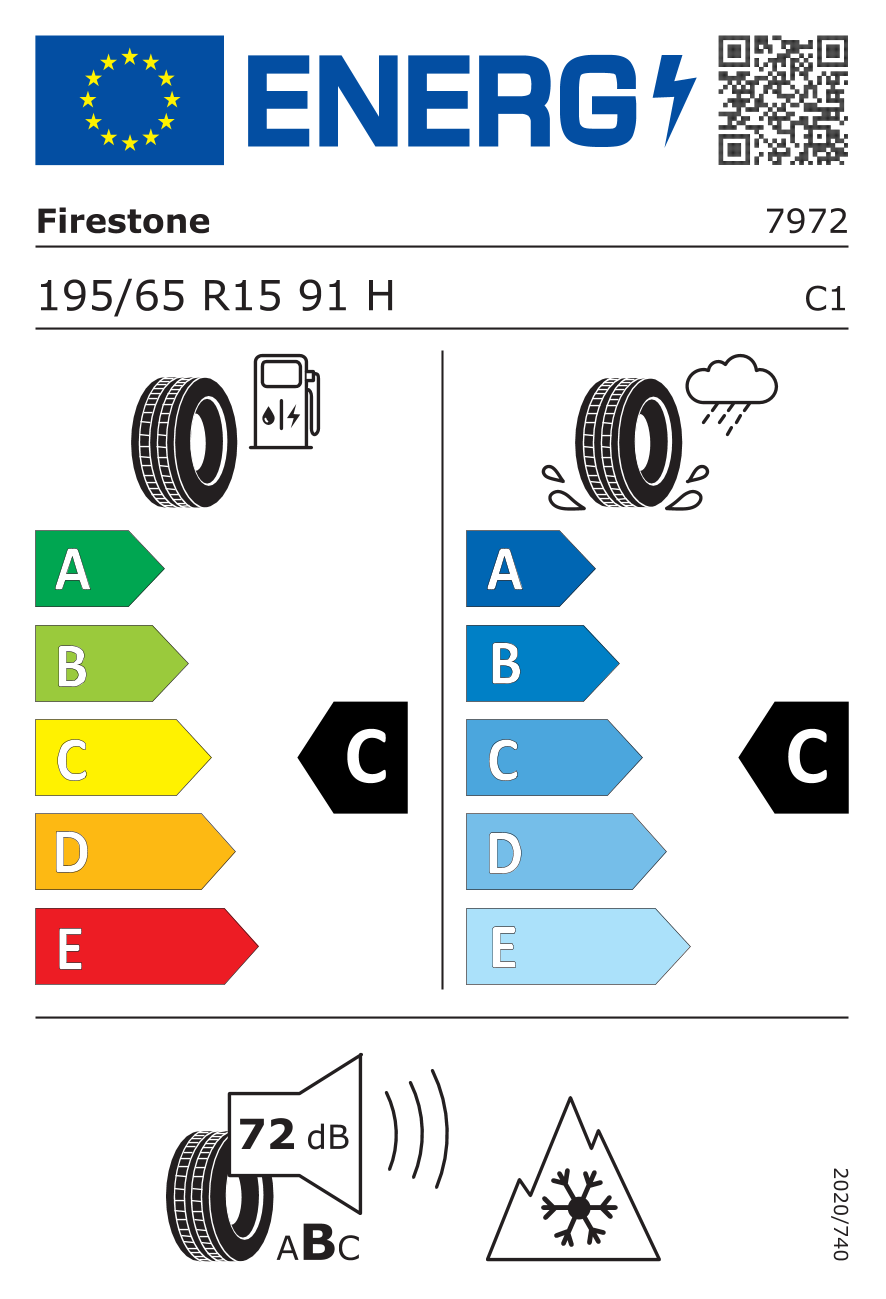
- EU Tyre Label:
- Client reviews rating
Firestone Multiseason
Designed to perform in all conditions, so the weather never catches you by surprise.
The extra convenience and cost savings of a single set of tyres, all year round.
Compliant with winter tyre legislation in all relevant countries.
Freedom to drive in all conditions
The Multiseason is safe when you need it the most by combining an overall easy-going and forgiving character on the road with a readiness for sudden weather change.
Its development started with a base pattern proven strong in wet and snow conditions. Thanks to the right amount of grooves for efficient water evacuation and the use of Nano-ProTech© technology in the compound, the Multiseason provides good wet grip and excellent resistance to hydroplaning, which means that it is able to evacuate large amounts of water quickly so you don’t lose control of your car.
The Multiseason also brings you confidence when driving on snow, as demonstrated by the M+S and 3 Peak Snowflake marks. Thanks to the right pattern to provide solid traction, handling and braking when driving on frost and snow, the Multiseason makes sure that drivers are free to take the road under any conditions.
Being a strong performer in wet and winter conditions is however not a trade-off for enjoying the daily ride! The Multiseason is ideal for manoeuvering in cities and with its linear steering and excellent stability, you can confidently engage any corner, making the drive smooth and comfortable.
Introduction
Since 1st November, 2012 all tyres made after 1st July, 2012 must show the European Tyre Label.
Benefits
The European Union has developed this new provision to promote economic and ecological efficiency and ensure road safety.
Disadvantages The Tyre Label can provide an overview and give the customer more transparency, but it only covers three criteria. For an extensive evaluation of a tyre, however, far more performance characteristics are relevant. Especially in the search for suitable winter tyres the test results from different test institutions such as the ADAC are much more stringent.
We'd like to point out that it is the manufacturer that labels the tyre and provides us with this information. If you do not find the label values, either the manufacturer did not inform us of the label, or the product was manufactured before July, 2012. Before that date, tyres had not yet been required to carry a label, so in some cases it is possible to purchase a tyre without a Tyre Label.
Symbols
The tyres are classified in terms of three performance characteristics:
• Fuel Efficiency (letters A to G)
• Wet Grip (letters A to G)
• External Noise
Take action
Finally, it is the driver that determines the fuel consumption. In order to reduce this over the long-term, by being careful during acceleration drivers can become more fuel-efficient and environmentally conscious.
Regularly checking tyre pressure helps to improve rolling resistance, reduces energy loss, and supports optimum adhesion in wet conditions. To reduce the risk of accidents and ensure your and the safety of other road users, always keep a reasonable distance.
More information: http://ec.europa.eu/energy/efficiency/tyres/labelling_en.htm
Choose from our large online selection or ask us for advice. Our experts are happy to help you choose the appropriate tyres from our extensive range of products.
The classification in terms of fuel efficiency is divided into seven classes, from the A-class (the highest) to G-class (the lowest). A tyre in the A-class consumes 0.1 litres less at 100km than a tyre in the B-class. An essential component for fuel efficiency is the rolling resistance or rolling friction.
Rolling Resistance
Rolling resistance is the force that opposes motion. It is formed, for example, when a wheel is rolling. Rolling resistance depends not only on the geometry but also on the properties of the material.
Average Average value is between C-E. Class D is not used.
It shows how efficient the vehicle can brake on wet roads. Wet grip is an important feature especially with summer tyres. Class A has the highest safety and the shortest braking distances. Class F has low security and the longest braking distance.
The wet grip classes are based on test driving on wet roads with a speed of approximately 80 km/h. The difference between the braking distance of the tyres is 3-5 feet per grade. E.g., the difference in braking distance between Class A and Class F are up to 18 metres.
Average The average value of the tyres is between class B-E. Class D and G is not used.
The symbol indicates the external rolling noise in decibels and as a 3 class sound wave symbol to clarify whether the tire can keep the recommended level. External rolling noise does not correspond to tyre noise inside the compartment.
A continuous sound level above 80 decibel can cause health problems.
Symbol
Three sound waves symbolize the worst results. These are the tyres that exceed the maximum limit of approval. A symbol of 2 sound waves have noise level that corresponds with the approved sound level. Tyres that are marked with 1 sound wave are over three decibel quieter than the approval.
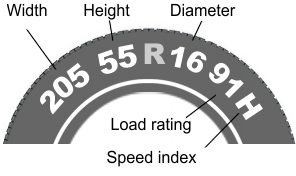
The exact size of a tyre can be found on its sidewall.
The following chart shows you how to read a tyre size.
2. The height as the ratio between the width and the height in %
3. Construction type: "R"= radial (often seen), "D" or "-"= diagonal (rarely seen)
4. The required rim diameter (in inches) for this tyre
5. Load index
6. Speed index